
Please note that the Equine Touch is not intended in any way, in whole or in part, to be a substitute for orthodox allopathic veterinary practise. It is always recommended when faced with a horse presenting colic symptoms to call for veterinary help.
I have had 3 horses over the past 30 years - one of whom was extremely prone to spasmodic colic - and a second who suffered both spasmodic and impaction colic for different reasons. Both types must always be treated as emergencies, although using ET can help enormously.
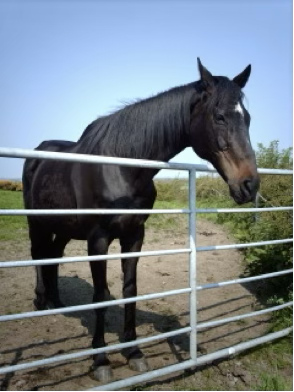
I adopted Jay from a friend and as soon as he was stabled realised that he wind-sucked, particularly when he was/had been eating. This made me think - being thoroughbred - that the was most likely stress perhaps causing stomach issues. I consulted our vet, who said when he saw him that there was no need to scope as he was sure that he had ulcers.
So we started into our life together - which was rather fraught as he was also extremely fast (‘Wall of Death’ in the Indoor!) Fortunately Heather McReynolds is local and came to see him. It turned out that not only was he gut-sensitive, but he had problems with his poll and a back molar hook, affecting his TMJ (temporal mandibular joint) and therefore the set of his whole body!
Fortunately, Equine Touch solved the majority of these issues together with expert dental care which sorted the jaw. He responded so well to ET - and as other problems resulting from a few years Hunt Chasing had left him with the injuries such as a badly fused pelvic injury which meant he would require regular maintenance, I was persuaded to learn ET for myself.
Jay first colicked when he went on holiday with one of his friends while I was away - apparently due to the change in grazing. He was pretty bad but recovered.
The next episode seemed to be due to changing daily routine in Autumn, where he was stabled more and was on haylage. Other occasions involved introducing the new year’s haylage, changes in hard feed - or even warm, wet grass! Limited grazing and the variation of the weather also meant that there were long spells with limited turnout and not enough opportunities for exercise.
If caught early, i.e as soon as he seemed anxious and in some pain, the Body Balance seemed to sort it, usually with a good release of gas from the Caecum (jet propulsion!). Walking helped but if he needed to roll he was allowed (although I was told he could twist his gut) and often that was enough to move the trapped gas. Sometimes, if he wasn’t open to touch, just performing the Hindquarters and the Sciatic Procedures would give sufficient pain relief and gas release. Folks on the yard thought he was like a cat - it seemed that he had 9 lives!
A couple of years later, Jay was out of action with a fractured hock, (from which he fully recovered) so I took on Molly, another thoroughbred, who also suffered from colic occasionally, but more often impaction colic.
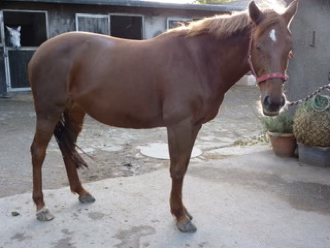
Bring very ‘sharp’, if she spooked or got upset when starting work - that was it! ET helped her in many ways; from aiding injury recovery to managing stress.
Once we know there’s an issue - and especially if the horse knows Equine Touch and how it can help - the horse can be worked with in a safe space (normally outside) and the effect can be amazing.
Jay had so many bad bouts of colic that we never knew when his time would be up, but after doing some Equine Touch on him, often the Vet would arrive and be surprised that his heart rate was ok, and that he hadn’t gone into shock.
The endorphins released through the Body Balance calmed the situation and the gut relaxed, but his Caecum, however, would sound like a washing machine with the overactive bugs! In all instances painkillers and sometimes a relaxant were sufficient to help him.
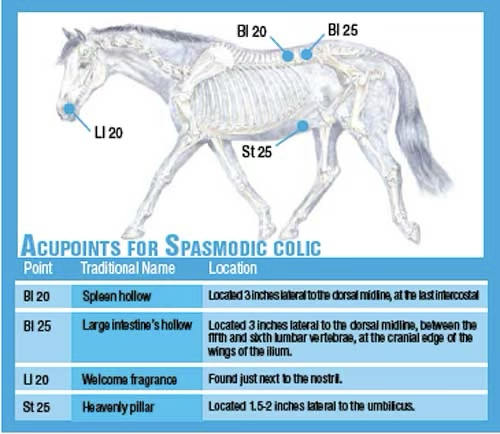
Understanding how the horse’s gut functions - and how it therefore can be easily upset - helps to predict and avoid potentially dangerous situations.
Spasmodic colic occurs in the small intestine in the caecum, which is the fermentor for food (grain or grass-based). The ‘biome’ consists of a blend of bacteria which digests the cellulose, releasing nutrients which are then absorbed into the bloodstream.
However, like in ourselves, changes in the bacterial composition (flora biome) of the caecum, sugar and yeast content of food or external temperature can affect the level of activity in the caecum. This results in overproduction of methane gas and bloating to the extent that when trapped it causes pain, ranging from mild to severe.
Unfortunately it is impossible at the beginning of an attack to predict just how bad it might become, which it is why it should always be treated as an emergency. If by any chance the horse appears ok when the vet arrives, all is well and good but this can’t be predicted- it is always better safe than sorry when it comes to calling the professionals.
Impaction colic is what we normally term constipation i.e that the faeces in the colon has compacted and stuck. This may be because the faeces has either moved too slowly through the intestine so that too much water has been re-absorbed from it or that the animal is dehydrated - either from not drinking enough or losing too much water such as through sweating.
In this instance it is the left side of the horse that is affected. Performing the Body Balance and sciatic procedure should help to relax the gut and often results in movement of the faeces. Using pressure on specific acupressure points can also help - provided the horse is quiet enough to allow this to take place safely. Repeat them as long as horse is receptive.
Feeding a Colic-Prone Horse.
The main aim of the game (for all, but especially sensitive) is to feed adequate amounts of fibre and energy to provide for the horse’s needs whilst taking care to not upset the balance of microorganisms in the intestine.
Hay is always preferable to haylage as it is not so rich. The nutrient levels in haylage vary enormously depending on which cut it is but it often causes digestive disturbance (and Laminitis) with native breeds in particular - breeds which have evolved to survive on basic native plants.
When introducing or changing feeds always do so gradually over a few days - giving the gut time to adjust/adapt.
Likewise, when turning out onto new grazing, in Spring - or when there has been a warm wet spell with new, limit the time out initially. It’s amazing how much a horse/pony can stuff in a relatively short period.
Pay attention to the condition of your horse’s poo - picking up on significant changes e.g. dry/hard indicates risk of impaction.
Supplements can help.g. Pre/Probiotics - which help to populate the gut with good bacteria, balancing it.
These are also useful them if the horses have been treated with oral antibiotics, as these wipe out not only bad (infective) but good bacteria in the gut.
Antacids - basically settle the gut - help neutralise excess acid (as with ourselves).
Horses may have gastric ulcers in both fore and hindgut.
Using a double/single dose detox agent can help remove toxins circulating in blood, following colic/ infection.
Key Points in an Emergency
Always treat colic as an Emergency and call the Vet immediately - early intervention is always better if possible.
Of course safety for we humans is also an issue - as a horse that is distressed, agitated and possibly thrashing about in pain cannot be tackled safely.
When working with the horse, always place yourself in a safe position and be aware that horses in pain can be unpredictable.
Don’t attempt to help a colicky horse on your own - things can change rapidly.
If you have to - always wear protective gear (riding hat minimum).
Here’s to happy, healthy horses!!