
Helps Relieve Tension”
It is a phrase we often use when describing the benefits of our Equine Touch bodywork modality, as well as many other techniques available to our horses. But what do we actually mean by this?
Tension is the result of short or long term stress on the body and mind from internal or external factors that conflict or impede the ideal state which allows a healthy, calm and functional ability of the body and mind.
Examples would be:
✏️ Prolonged inclement weather and the impact this causes to the horse’s environment such as restricted movement and lack of herd socialisation, hoof abscesses and thrush, slips in the field or lack of quality rest.
✏️ Ongoing lameness from accident or illness which causes the body to build supporting compensatory patterns.
✏️ Incorrect or unsuitable tack and equipment such as training gadgets, poor fitting saddles or unbalanced riders.
✏️ Misunderstood behavioural signals that lead to reprimand or unheard needs for change by the horse.
✏️ Emotional distress such as loosing a companion or separation anxiety or unable to escape a pressurised situation such as being forced into an unnatural frame.
These are a few examples but on a day-to-day basis I encounter many more. Some of which are out of our control and some that we can listen and learn to help improve the welfare of the horse.
The purpose of applying The Equine Touch bodywork is to provide a moment of relief, create new awareness and change habitual patterns, open the door to the horse’s innate healing ability and encourage the parasympathetic nervous system response ‘Rest & Digest’ also known as the healing state to work its magic on the body and mind of the horse.
When we are working, we are looking for these compensatory holding patterns, that hold tension within the body then by gently creating space and movement where there previously has been resistance and lack of flow physically and energetically that can cause pain and discomfort, brings relief.
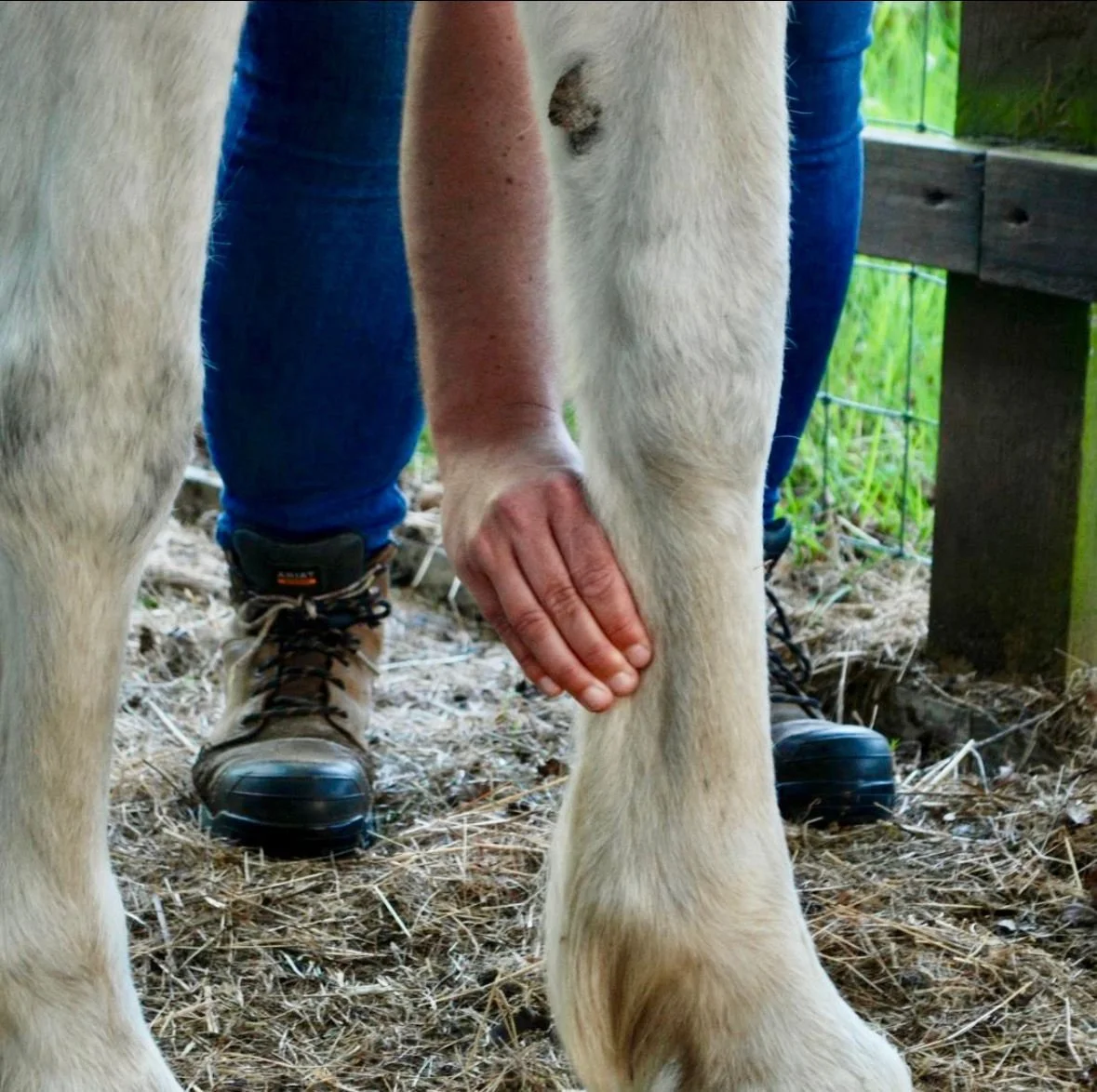
Assessing the forelimb during a session.
So what does this look and feel like?
You might observe subtle signs such as worried eyes, a tense jaw and ears placed diagonally, a clamped tail, loose droppings or the inability to settle when tied up.
Physical signs such as an irregular rhythm in movement that you may observe visually and by sound, consistently resting a particular limb or often switching legs. Not happy with touch in particular places such as the poll or stifle or moving away from pressure such as dipping the back when palpating the spine.
You can also find lack of movement in the soft tissue and fascia of the body, this will feel stuck or hard to move, maybe a change in temperature hot or cold or potentially lumpy or lacking structure and tone.
When I am working with a horse, I am looking for balance across the whole body, or lack of. I will observe the horse’s behavioural responses and be guided by them as to how I approach the session with them. I am feeling for these changes in tension and gently, slowly encourage new movement in the area by stretching the fascia, creating new space for nerves, blood vessels, lymphatic vessels that sit within the fascia and open up space between the muscles, tendons and ligaments. This in turn brings greater range of movement within joints and will encourage better balance and structure across the skeletal system.
I am also feeling for energy, often this feels like a warm buzzing sensation, or an unseen but tangible feeling of pressure like touching jelly and then moving with it. Sometimes I will feel this directly on the body, sometimes I will feel it a couple inches off the body. All the time observing the horse’s reactions.
By changing this tension in the body and mind, we are helping the horse positively but also being mindful that some of these tensions such as habitual patterns are protecting the horse from a bigger problem and so we do not want to make any changes too fast or too hard. This is why The Equine Touch works slowly across a number of sessions utilising one of the most important requirements to change, which is time.
This is, in a rather large nutshell, what it means to help relieve tension in a bodywork session.